
How big is big?
A question I am asked a lot is “how do you define a major gift”? And I always draw this (not always this neatly):
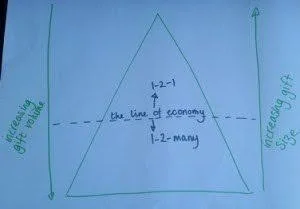
The line of economy marks the point at which it is no longer economically valid to adopt a one-to-one approach with that donor and so you move to a one-to-many approach.
Why there is no single definition of a major gift
I can’t tell you where that point is without doing some analysis. Nor can you.
One thing I often don’t explain is that it is unlikely that your donor-volume-by-gift-amount would create a neat pyramid. In fact the gift pyramid for one client I’ve worked with recently would look like this:
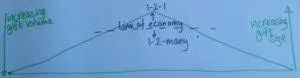
This charity does very well from lots of small gifts, with a only few trusts and wealthy individuals making significant gifts and a few companies offering significant in-kind support.
And another like this:
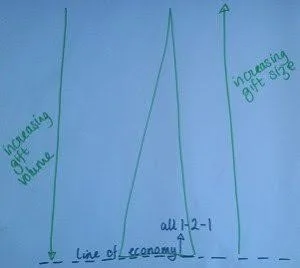
This charity only gets donations from a few key organisations: charities, trusts and companies. They get no small-level donations at all.
Based on donation type (and definitely based on knowing them) they have little in common. Except that they both have a line of economy, whether they consciously know it or not.
How to set the right threshold for your organisation
Big Gift, Major Gift, Major Donor – call it what you will – Fundraising isn’t defined by a set gift amount. It is defined by its approach: taking the time to develop a relationship with a person over time in order to ask for a commitment.
This approach makes most sense with the tip of your giving pyramid: those who do (or can) give the highest amounts. This offers the best return for your investment of time, effort, energy (and budget). How far down you go depends on the gift potential versus the cost of time, effort, energy (and budget) making sense.
What to do once you have your number
Once you've worked out your line of economy, the real work starts. Everyone above that line should be moving onto a relationship-led, one-to-one approach: a named contact, tailored communication, time invested in understanding what matters to them before you ever make an ask. Everyone below it stays in efficient, one-to-many stewardship.
The test isn't whether you've drawn the line. It's whether your current activity matches it. Pull a list of everyone above your threshold and ask honestly: are they getting that one-to-one treatment, or are they still getting the same appeals as everyone else? If it's the latter, you haven't found a donor problem, you've found an action gap, and that's a more useful (if less comfortable) thing to know.
And don't treat the number as fixed. As your major donor programme matures, your capacity changes, and so does the line. Revisit it every year, not because the maths demands it, but because your organisation will have changed enough to make last year's threshold wrong.
Find your programme's starting point
Our free Major Donor Scorecard helps you assess your major donor programme — including whether your prospect segmentation is working as it should.